Anxiety
American PsychoAnxiety is one of the most persistent states in Patrick Bateman’s experience, linking apparently controlled scenes of Manhattan privilege to episodes of physical panic, memory failure, and impending violence. It is not simply an occasional reaction to danger. It recurs in restaurants, offices, gyms, apartments, clubs, and elevators, often beneath an immaculate surface of designer clothing and practiced manners. The contrast makes anxiety a measure of the instability hidden inside his social identity: the more carefully the exterior is maintained, the more violently the body and narration register its collapse.
Bodily Panic and Disorientation
Anxiety is first rendered as a crisis of the body. On a Thursday afternoon, Patrick stands at an unidentified downtown phone booth, sweating with a pounding migraine and experiencing what he calls a major-league anxiety attack. He searches a Gucci pillbox for Valium, Xanax, or Halcion but finds only three faded Nuprin, which he swallows with Diet Pepsi. The episode is intensified by radical disorientation: he cannot remember whom he had lunch with or where, and he moves through competing possibilities involving Robert Ailes, Todd Hendricks, Ricky Worrall, and Kevin Weber, as though the city’s restaurants have replaced stable memory with a catalogue of interchangeable names and tables.
The telephone does not restore order. Patrick reaches Jean amid Broadway traffic, but he cannot clearly identify his location, his appointments, or even the reservation he is trying to discuss. Jean supplies a succession of social obligations, including dinner at Melrose and drinks at Harry's, while Patrick struggles to answer where he is and whether he can go to the office. His speech fragments into cries for help, irritation, and the slogan Just Say No before he abruptly hangs up. Anxiety therefore appears not only as fear but as a breakdown in sequencing: work, leisure, medication, place, and identity lose their distinctions.
A later encounter reduces the same condition to a visible social symptom. When a man asks whether Patrick is all right and observes that he seems nervous, Patrick responds by asking why the man would think so. The exchange exposes the pressure beneath his composure without explaining it away. His anxiety remains both public enough to be noticed and opaque enough to be denied.
The Social Mask Under Pressure
Patrick’s anxiety repeatedly collides with the rituals through which he presents himself as secure and desirable. At Evelyn’s brownstone, he and Timothy Price arrive late, and Patrick performs polished etiquette with Courtney Lawrence: he hands her his black wool Giorgio Armani overcoat, receives an air kiss, and watches her repeat the same movements with Price. The Talking Heads plays softly, the clothing is exact, and the greeting is rehearsed, yet the scene’s controlled surface carries an underlying chill. Social fluency functions as a mask rather than evidence of emotional stability.
The same compensatory logic governs Patrick’s gym routine. At Xclusive, he moves rapidly past Cheryl, who is in love with him, because he wants the Stairmaster before a line forms. He worries about being watched, catalogues bodies and clothing, and follows a highly technical program combining aerobic exercise, free weights, and machines with hydraulic, pneumatic, or electromechanical resistance. The precision of the regimen gives anxiety a measurable form. Calorie expenditure, muscle definition, resistance settings, grooming, and clothing promise control over a self that otherwise feels difficult to locate.
The business card scene offers a miniature version of this strategy. At dinner, irritated that Craig McDermott knows the maître d', Patrick tries to even the score by displaying a new card pulled from an $850 Barney's gazelleskin wallet. He slaps it onto the table and waits for the others’ reaction, smiling proudly while attempting to appear casual. The object is a social credential, but his need to stage it reveals how precarious the credential feels. Anxiety is displaced into comparison, display, and the demand for recognition.
Sexual Risk, Disease, and Aggression
Anxiety also circulates through the period’s fear of AIDS and the body’s vulnerability. Courtney Lawrence tells Patrick that Stash has tested positive for the AIDS virus and may sleep with Vanden that night. The information is delivered during sex, while the television’s volume rises and falls, and Patrick answers with apparent indifference before Courtney calls him evil. The scene converts medical danger into another component of eroticized detachment: the possibility of infection is acknowledged, but compassion and caution are displaced by performance.
The conflict becomes explicit when Courtney protests unsafe sex. Patrick argues over the placement of the condom, treating its physical position as a technical proof that should settle her fear. Courtney, crying, explains that she expects a promotion, is going to Barbados in August, and does not want Kaposi’s sarcoma to ruin the trip or prevent her from wearing a Norma Kamali bikini bought at Bergdorf Goodman. Her anxiety is concrete and bodily, but Patrick answers it with ridicule, coercion, and control. The scene shows how disease fear is transformed into moral judgment and aggression rather than care.
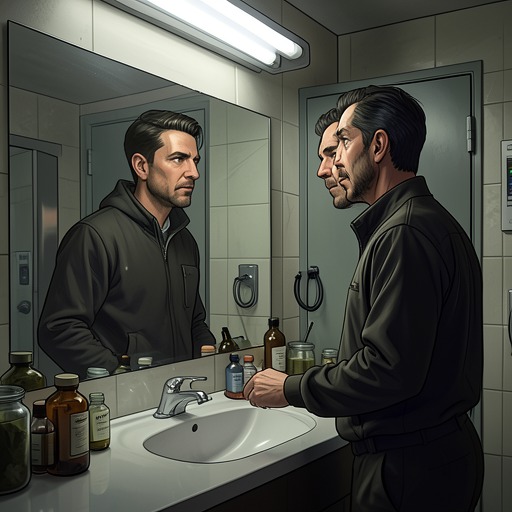
Patrick’s own anxiety is similarly redirected into fantasies of domination. At the Yale Club, while sitting with David Van Patten and Craig McDermott, he wonders whether Courtney Lawrence would spend more time with him if Luis Carruthers were dead. The thought develops into questions about strangling Luis or having him hacked to bits, and then into a movement toward the men’s room. Patrick checks his perfect teeth in the mirror, puts on leather Armani gloves, and approaches Luis in an unlocked stall. The polished self-inspection immediately precedes the assault, making the mirror and gloves instruments of transition from social anxiety to violent control.
Memory, Repetition, and Escalation
Anxiety grows more pervasive as Patrick’s memory and reality become less dependable. During the summer, he spends much of his time in a stupor—in restaurants, cabs, nightclubs, movie theaters, his apartment, and the abandoned building in Hell’s Kitchen. Repeated television images of air disasters, wreckage, burned bodies, and rescue workers retrieving remains become part of the surrounding media environment. At dinners with summer associates, he asks about The Toolbox Murders on HBO and meets silent, uncomprehending stares, then retreats into restaurant orders and the mechanics of payment.
The details of consumption continue even as control fails. His platinum American Express card snaps in half after heavy use at a dinner, forcing him to pay with cash from his gazelleskin wallet. The Patty Winters Shows are repeats, life feels blank and formulaic, and Patrick describes himself as lethal and close to frenzy. Anxiety here is not relieved by abundance; it is intensified by repetition. Restaurants, cards, clothing, television, and nightlife recur so mechanically that they no longer distinguish one day from another.
The resulting need to leave the city is presented as a response to mounting bloodlust. Patrick tells Evelyn Richards that he needs a vacation in the Hamptons, and she accepts. The movement outward does not resolve the condition. It merely relocates a crisis that has already spread from nightly violence into daytime consciousness. Anxiety becomes the bodily threshold of an escalation that the social world cannot recognize because it continues to reward the appearance of normality.
Fear After Violence and Narrative Uncertainty
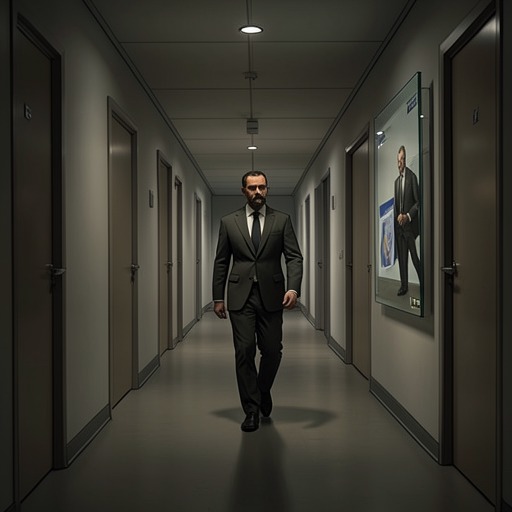
After the violent sequence involving the night watchman and janitor, Patrick reaches what he believes is his new office, signs in with Gus, and takes the elevator upward. Once temporarily sheltered by office anonymity, he retrieves Harold Carnes’s number and leaves a message confessing everything, including thirty, forty, or a hundred murders. He is exhausted, shaking, and sobbing while a helicopter, police cars, ambulances, and a SWAT team converge on the building he has just left. He also says that he left a woman in a parking lot near a Dunkin' Donuts somewhere around midtown, then concludes that he is a pretty sick guy.
The episode makes anxiety inseparable from uncertainty about what has actually occurred. Patrick’s confession sounds like an attempt to make private dementia public, yet the surrounding action is narrated with the same unstable intensity as his fantasies. The message to Harold Carnes promises disclosure, but its exaggerations, gaps, and shifting details provide no secure external confirmation. Anxiety thus belongs simultaneously to character and form: Patrick fears exposure while the narrative withholds a stable account of the events that might expose him.
This instability returns when Patrick visits Paul Owen’s former apartment with a real estate agent. He knows, or believes he knows, that he has never returned after murdering the two girls there, and the knowledge produces an icy sensation in his chest. He wonders how much the apartment is worth, hears voices inside, anticipates that the locks have been changed, and then is confronted by a broker who asks whether he is her eleven o’clock appointment. Patrick denies it. The scene turns memory into an anxious intrusion: the apartment remains charged with the past, but the present social world treats it as a property viewing rather than a crime scene.
Anxiety therefore becomes the clearest recurrent signal that Patrick’s apparent mastery is failing. It emerges through sweating, migraines, tears, tight muscles, shallow breath, nervousness, confusion, and the inability to remember where he has been. Yet the narrative never grants it a stable therapeutic or moral resolution. Instead, anxiety is repeatedly covered by clothes, cards, reservations, workouts, drugs, sex, and professional language. Its final significance lies in that repetition: beneath a culture organized around immaculate surfaces, the body keeps announcing a reality that Patrick and everyone around him are unable—or unwilling—to name.